Key Takeaways
I have chosen ten Australian novels that bring wit, unease, tenderness, and a healthy amount of trouble to the page. Together, they make a persuasive case for keeping a little Aussie fiction on the reading pile.
- Miles Franklin and Joan Lindsay turn ambition and mystery into unforgettable literary forces.
- Tim Winton and Peter Carey explore family, faith, desire, and spectacularly bad decisions.
- Kate Grenville and Tara June Winch ask difficult questions about land, language, and inheritance.
- Christos Tsiolkas, Craig Silvey, Graeme Simsion, and Steve Toltz bring sharp voices to conflict, romance, and family life.
- These novels reward discussion, disagreement, and the occasional dramatic pause over tea.
1. My Brilliant Career by Miles Franklin: ambition before brunch was a thing
Miles Franklin’s My Brilliant Career has the restless energy of someone who has been told to sit quietly and has decided, on principle, not to. Sybylla Melvyn is young, clever, ambitious, and thoroughly unimpressed by the narrow expectations placed before her. I admire how quickly the novel makes her feel alive: prickly, funny, vain, generous, and impossible to tidy into a respectable little box.
The novel’s pleasures come from that friction between wanting more and knowing exactly what the world expects a young woman to accept. Sybylla wants art, independence, and a life that feels like her own, yet she is also conscious of money, class, family obligation, and the humiliations of dependence. Her voice gives the book its snap, especially when romantic possibility arrives carrying the faint odour of social compromise.
What keeps the novel fresh is its refusal to make ambition perfectly graceful. Sybylla can be dramatic, self-absorbed, and wrong, but her hunger for a larger life never feels silly. I would recommend it to anyone who enjoys a narrator with opinions, particularly when those opinions arrive before breakfast and refuse to leave.
2. Picnic at Hanging Rock by Joan Lindsay: mystery, mayhem, and missing schoolgirls
Joan Lindsay’s Picnic at Hanging Rock begins with the polished rituals of Appleyard College and gradually lets the Australian landscape make those rituals look rather flimsy. A school outing becomes a disturbance in the ordinary order of things, and the central mystery gains power because it is never reduced to a neat explanation. I find the book most unsettling when everyone behaves as if decorum might hold the world together.
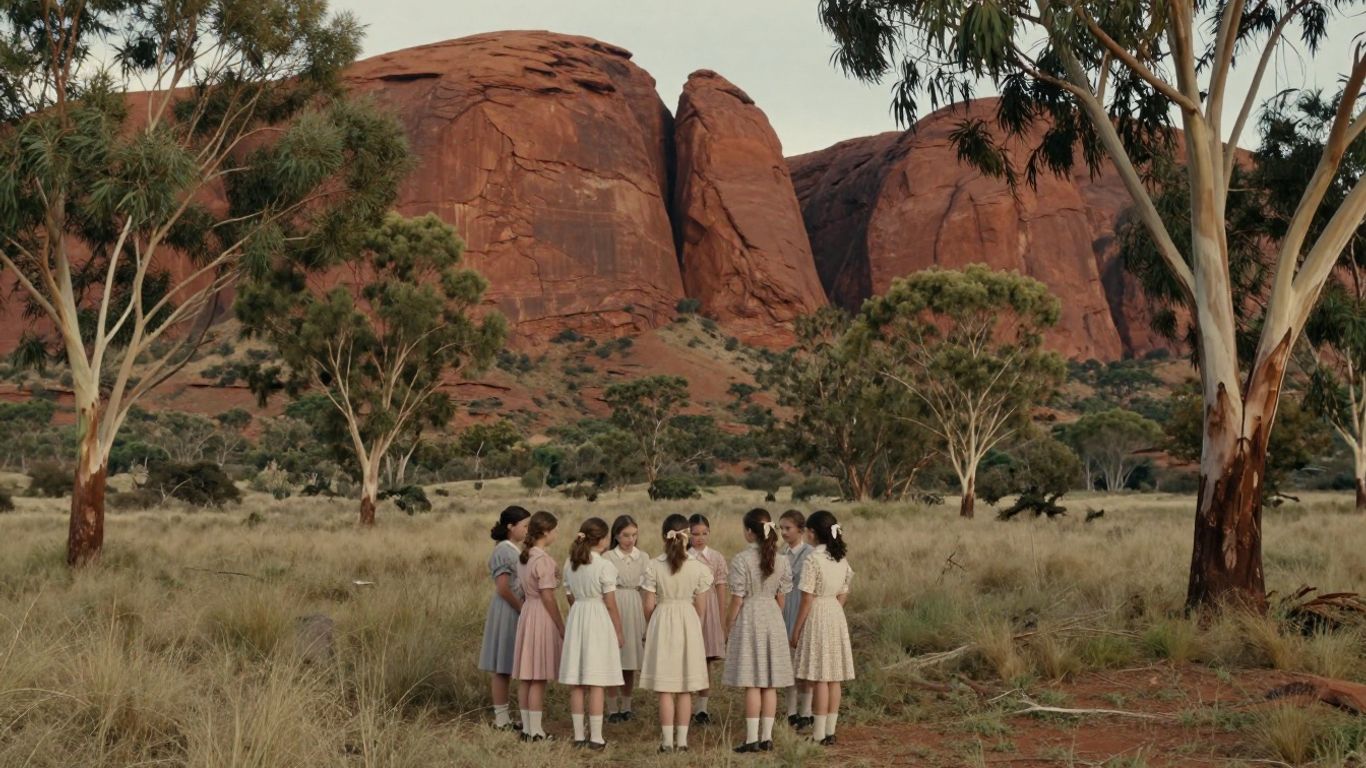
The novel’s atmosphere is its most persuasive trick. Heat, rock, lace, flowers, uniforms, and silence gather around the characters until the setting feels less like scenery than a presence with its own temperament. Lindsay understands that a mystery can become more haunting when answers are withheld, allowing gossip, memory, and imagination to crowd into the empty space.
I also enjoy the way the book unsettles authority without making every rebellious impulse admirable. The adults are constrained by reputation and propriety, while the girls move through a world they do not fully understand. It is an ideal book-club choice because readers can argue over what happened, what was imagined, and whether certainty would improve the story or ruin its delicious chill.
3. Cloudstreet by Tim Winton: family drama on a grand Australian scale
Cloudstreet is a sprawling family novel, but its large cast never feels like an excuse to avoid intimacy. Tim Winton brings two families into one battered house and lets their histories, habits, resentments, and hopes collide over decades. I read it as a book about survival, although survival here includes cooking, quarrelling, forgiving, and finding room for one more person at the table.
A simple comparison helps explain the novel’s changing energies without flattening its richness:
| Element | What it brings to the novel | Why it matters |
|---|---|---|
| The house | A shared physical and emotional space | Private histories become impossible to keep private |
| Food and work | Daily labour and practical care | Love appears through repetition rather than speeches |
| Memory | The past pressing into the present | Old wounds shape choices long after the original event |
| Chance | Sudden turns and unlikely connections | Nobody controls the family story completely |
The table is only a map, because Cloudstreet keeps crossing its own boundaries. Work becomes affection, memory becomes a kind of haunting, and the house becomes both refuge and trap. That is why the novel feels so generous: it allows its people to be difficult for a long time and still leaves room for them to change.
Winton’s prose can move from the earthy to the mystical without apologising for either. I like that confidence, particularly in a family saga that refuses to behave like a tidy family tree. Reading it feels a little like attending a reunion where everyone has brought unresolved business, a strong appetite, and several opinions about how the past should be remembered.
4. Oscar and Lucinda by Peter Carey: love, faith, and one very ill-advised glass church
Peter Carey’s Oscar and Lucinda pairs two unusual people whose convictions are both sincere and, at times, spectacularly impractical. Oscar is shaped by religious belief, while Lucinda is shaped by independence, commerce, and a fascination with possibility. Their connection is compelling because neither person is simply rescued by love; instead, their meeting gives their existing obsessions a larger and more dangerous stage.
The glass church at the heart of the novel is an extraordinary object and an even better source of trouble. It turns faith into architecture, ambition into logistics, and romance into a project requiring transport through a difficult landscape. I enjoy the absurdity of it, but the absurdity never cancels the emotional stakes. Carey makes grand gestures look beautiful, costly, and faintly ridiculous all at once.
The novel also asks what happens when private belief encounters institutions, money, gender, and colonial power. Its historical setting is not a decorative backdrop; it shapes what the characters can imagine and what the world will permit them to do. I finished it thinking that love may inspire magnificent acts, but it does not necessarily improve anyone’s judgement.
5. The Secret River by Kate Grenville: history, guilt, and the cost of claiming land
Kate Grenville’s The Secret River follows William Thornhill into colonial Australia, where the hope of starting again is tangled with violence and possession. Thornhill wants security for his family, and that desire is recognisable even when the actions it enables become increasingly disturbing. The novel’s force comes from making the reader watch a private dream collide with a larger history that cannot be made innocent.
Grenville keeps the moral questions close to the ground. Land is not an abstract prize: it is a place inhabited, worked, named, remembered, and defended. Thornhill’s uncertainty matters, but the novel does not allow uncertainty to erase consequence. I find that balance difficult and valuable, particularly because it asks readers to examine the stories nations tell themselves about belonging.
The book is also attentive to the small decisions that build toward catastrophe. A glance, a boundary, a claim, or an act of silence can acquire dreadful weight when repeated across a community. I would choose it for a reading group prepared for serious conversation, because its central questions do not end when the final page does.
6. The Slap by Christos Tsiolkas: one backyard incident, eight combustible perspectives
Christos Tsiolkas begins The Slap with a single incident at a suburban gathering and then refuses to let anyone enjoy the comfort of a single version of events. Each perspective alters the emotional temperature, exposing loyalties, resentments, prejudices, and private fantasies. I find the structure clever because it turns disagreement into the engine of the novel rather than a problem to be solved.
The book is deliberately abrasive. Its characters do not always say what a decent person is supposed to say, and their inner lives are often less flattering than their public manners. Yet that discomfort is the point: a social group can appear cohesive until one moment reveals how differently its members understand respect, family, authority, and harm.
What I appreciate most is the way the novel makes judgement unstable without making it meaningless. A new viewpoint may complicate my response, but it does not force me to treat every action as equally defensible. The Slap is therefore excellent book-club material, provided everyone agrees that passionate disagreement is part of the evening and nobody brings a ceremonial gavel.
7. Jasper Jones by Craig Silvey: small-town secrets with a sharp coming-of-age edge
Craig Silvey’s Jasper Jones gives Charlie Bucktin the uneasy task of growing up in a town where adults have secrets and children notice more than they are meant to. The arrival of Jasper Jones pulls Charlie into a frightening discovery, but the novel is about more than one mystery. It is also about racism, friendship, family violence, shame, and the slow process of learning whom to trust.
Charlie’s perspective gives the story both vulnerability and bite. He is observant but not all-knowing, and his attempts to make sense of adult behaviour often expose the absurdity of the explanations offered to him. I particularly enjoy the contrast between his inward caution and the reckless courage demanded by the situation he has entered.
The novel’s small-town setting magnifies everything. A rumour can become a verdict, a family reputation can behave like a sentence, and silence can look like safety until it is too late. Silvey keeps the coming-of-age elements emotionally grounded, so Charlie’s growth feels less like a heroic transformation than the painful beginning of seeing the world clearly.
8. The Yield by Tara June Winch: language, inheritance, and reclaiming a family story
Tara June Winch’s The Yield is a novel about returning: to a place, to a family, to a language, and to histories that official accounts have tried to smooth away. August Gondiwindi comes back after the death of her grandfather and discovers that inheritance is not limited to property or objects. It can also be a vocabulary, a set of memories, and a demand to listen properly.
The novel’s strands offer different ways of holding a life together. I found it useful to think of them as three forms of inheritance:
- The written record preserves a grandfather’s knowledge and observations.
- The family story carries grief, affection, conflict, and memory across generations.
- The words of language restore meanings that cannot be replaced by convenient English approximations.
These strands do not sit apart like labelled exhibits. They answer, challenge, and deepen one another, gradually showing how language can carry a relationship to Country. The result is moving without being sentimental, because recovery is presented as work: patient, painful, and shaped by what has already been lost.
I admire the novel’s insistence that a family story can be both intimate and political. August’s return is personal, but it also opens questions about whose knowledge is recorded and whose authority is accepted. The Yield asks me to read more carefully, especially when a supposedly simple word has a whole world behind it.
9. The Rosie Project by Graeme Simsion: romance for people who prefer spreadsheets
Graeme Simsion’s The Rosie Project introduces Don Tillman, a highly organised genetics professor whose approach to romance resembles a research protocol with unusually poor field conditions. He creates a questionnaire to identify a suitable partner, believing that a careful system can protect him from uncertainty. Naturally, Rosie arrives and immediately makes the system look both ingenious and hopeless.
The comedy works because Don’s habits are not merely quirks placed on display. They are ways of managing a world that often feels confusing and unpredictable to him. His literal thinking produces awkward encounters, but it also gives him a directness that can be refreshing. Rosie, meanwhile, is not simply a chaotic force sent to improve his life; she has her own aims, frustrations, and questions.
I enjoy the novel as a romance because it treats connection as something learned rather than magically bestowed. Don has to reconsider what compatibility means, while Rosie has to decide what she wants from another person. The book is warm without becoming completely sugary, and it has the excellent quality of making a spreadsheet feel like a plausible opening move in matters of the heart.
10. A Fraction of the Whole by Steve Toltz: big ideas, bigger egos, and gloriously chaotic family life
Steve Toltz’s A Fraction of the Whole is narrated with the confidence of a man who has discovered several theories about life and is determined to test all of them aloud. Jasper Dean grows up under the influence of his brilliant, difficult father, Martin, whose ideas are as grand as his personal habits are destructive. Their family history becomes a comic battlefield where philosophy, resentment, love, and self-invention keep changing sides.
The novel is funny in a way that can be exhausting, then unexpectedly tender. Its characters make plans they cannot sustain and declarations they later regret, but the exaggeration reveals something recognisable about families: people inherit stories about themselves, then spend years trying to edit them. Toltz gives Jasper and Martin enormous egos without stripping away their vulnerability.
I would recommend this book to readers who enjoy a narrative that wanders because wandering is part of its design. It asks large questions about freedom, meaning, reputation, and whether a person can escape the version of them created by relatives. The answer is never simple, which seems appropriate for a novel where even affection tends to arrive wearing a slightly ridiculous hat.
Conclusion
These ten novels give me ten different reasons to keep reading Australian fiction: its appetite for difficult histories, unruly families, strange landscapes, sharp humour, and characters who resist being neatly understood. I would not expect every title to suit every reader, but I would happily put any of them on a book-club table and wait for the arguments to begin.
Frequently Asked Questions
What makes a novel Australian fiction?
Australian fiction is usually understood through its connection to Australian places, histories, cultures, communities, or ways of seeing the world. A novel need not be set entirely in Australia to engage meaningfully with those elements.
Are these books suitable for a book club?
Yes, although several contain difficult material and may prompt strong disagreement. That is often useful in a book club, provided the group allows space for different responses and gives sensitive topics the attention they deserve.
Which book should I read first?
I would begin with the title that best matches your mood. Choose The Rosie Project for an approachable romance, Picnic at Hanging Rock for mystery, or The Slap if you want a book designed to provoke debate.
Are all ten novels contemporary?
No. The list moves from Miles Franklin’s early twentieth-century novel through historical fiction, modern family sagas, literary mysteries, and contemporary coming-of-age stories. Their periods differ, but each offers a distinctive view of Australian life.
Which novel focuses most on Australian history?
The Secret River is the clearest choice for readers interested in colonial history, land, and the moral consequences of settlement. The Yield also examines history through family, language, Country, and the recovery of cultural knowledge.
Do I need to know Australian history before reading these books?
No, but some background may add useful context. I usually recommend reading first, noting the questions that arise, and then seeking reliable historical information rather than delaying the novel until I feel perfectly prepared.
What should I bring to a discussion of these novels?
Bring a response rather than a performance: a favourite passage, an unresolved question, or a character you could not stop thinking about. The best conversations usually begin when readers admit where a book surprised, irritated, or changed them.