Key Takeaways
I have chosen these novels for the range of Australian voices, settings, and moral questions they bring to a book-club table.
- The list moves from rural coming-of-age stories to historical fiction and psychological suspense.
- Australian landscapes often act as active forces rather than decorative backdrops.
- Several novels examine class, race, memory, family, and the stories nations tell about themselves.
- The books vary widely in style, so there is something here for both quiet and adventurous readers.
- I recommend choosing by mood, then allowing the discussion to become more complicated than the plot summary.
1. My Brilliant Career by Miles Franklin
I return to My Brilliant Career when I want a novel with an unmistakable pulse. Sybylla Melvyn is young, ambitious, stubborn, and thoroughly unimpressed by the limited future offered to her. Her voice has the snap of someone who would rather cause trouble than politely disappear.
The novel’s rural setting is not a postcard. Heat, work, money, and social expectation press in on every page, giving Sybylla’s dreams a practical obstacle course to navigate. Franklin makes independence feel exhilarating and exhausting in almost equal measure.
What I enjoy most is the book’s refusal to make self-determination tidy. Sybylla can be selfish, funny, perceptive, and maddening within the same chapter. For a book club, I would ask whether her resistance is a form of courage, immaturity, or both—and whether those categories are really as separate as we pretend.
2. Picnic at Hanging Rock by Joan Lindsay
Joan Lindsay’s Picnic at Hanging Rock begins with the manners of a school outing and gradually lets unease seep through them. The students and teachers arrive at the rock under a bright summer sky, yet the atmosphere never settles into simple leisure. I find that tension more unsettling than any overt explanation could be.
The novel is built around absence: missing girls, unanswered questions, and the gaps between what people see and what they claim to know. Its power comes partly from how long it allows uncertainty to remain uncertainty. I do not read it for a neat solution; I read it for the strange afterimage it leaves behind.
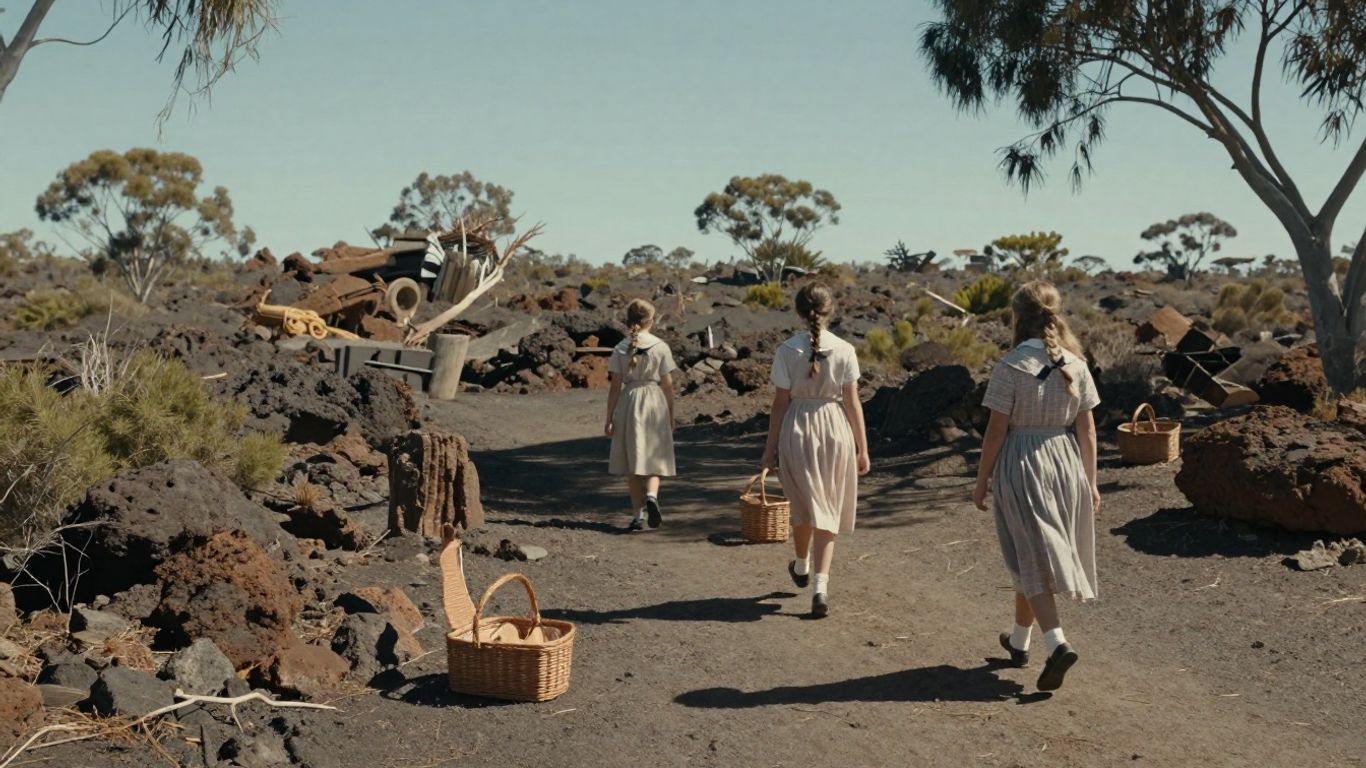
Lindsay also understands the menace of respectable surfaces. Uniforms, routines, and polite conversation create a fragile order that the landscape quietly ignores. In discussion, I like asking whether the rock is best understood as a place, a force, or a blank space onto which everyone projects fear.
3. Cloudstreet by Tim Winton
Cloudstreet follows the Pickles and Lamb families through a large, unruly stretch of Australian life. Their shared house becomes a pressure cooker for grief, affection, resentment, work, and improbable good fortune. I admire how Winton lets the family saga expand without losing sight of small domestic gestures.
The novel’s warmth is never simple. People hurt one another while trying to care, inherit burdens they did not choose, and make peace only after causing fresh damage. Winton gives the book a sense of spiritual weather, as if the ordinary world occasionally opens onto something larger and stranger.
For readers choosing among these aussie fiction must reads, this is the expansive option: crowded, generous, and willing to take its time. I find it particularly rewarding when read aloud in a group, because its humor and oddness become easier to share. It is also a useful reminder that family stories need not be orderly to feel true.
A quick way to frame the reading experience is to consider what each family brings into the house:
| Element | The Pickles | The Lambs |
|---|---|---|
| Temperament | Restless and opportunistic | Steady and devotional |
| Relationship to work | Improvised and precarious | Dutiful and sustaining |
| Emotional pattern | Conflict and volatility | Care and endurance |
The contrast is not absolute, which is why the novel keeps moving beyond a simple opposition. Both families contain generosity and selfishness, and the house gradually becomes less a symbol of division than a record of people learning, imperfectly, to live together.
4. The Secret River by Kate Grenville
Kate Grenville’s The Secret River places William Thornhill, a transported convict, on the Hawkesbury River as he tries to build a future for his family. His desire for land is understandable in the narrow sense of personal survival, but the novel steadily exposes the violence hidden inside that desire. I find its moral pressure difficult to escape.
The river and surrounding country are richly observed, yet beauty never softens the historical reality. Thornhill sees opportunity where others already have home, law, memory, and belonging. That clash gives the novel its central force and prevents the colonial past from being treated as a distant backdrop.
This is a book I would choose for a serious discussion rather than a breezy meeting. It asks how ordinary people participate in systems of dispossession, and how easily ambition disguises itself as necessity. The uncomfortable question is not only what Thornhill does, but what stories he tells himself afterward.
5. True History of the Kelly Gang by Peter Carey
Peter Carey’s True History of the Kelly Gang is written as a constructed confession, giving Ned Kelly a voice that feels intimate, defensive, and carefully shaped. The roughness of the prose is part of the experience: it sounds like a man trying to seize control of his own legend. I enjoy the way the novel makes storytelling itself part of the subject.
Kelly is neither reduced to a folk hero nor flattened into a villain. Family loyalty, poverty, police violence, pride, and performance push him toward the public identity that later generations inherit. Carey keeps asking how much of a legend belongs to the person and how much belongs to the audience.
The book is especially good for a group that enjoys arguing about unreliable narrators. I would encourage readers to notice what Kelly leaves out, repeats, or insists upon too loudly. A persuasive voice is not the same as a complete truth, and the novel makes that distinction thrillingly uncomfortable.
6. The Book Thief by Markus Zusak
Markus Zusak’s The Book Thief follows Liesel Meminger in Nazi Germany, where books, language, and acts of care become forms of resistance. Death narrates the story, an audacious choice that gives the novel a watchful, mournful intelligence. I find the narration oddly tender without mistaking tenderness for safety.
Liesel’s foster family creates a small moral world inside a brutal political one. The novel pays close attention to the physical life of words—how they are stolen, shared, painted, memorized, and used to wound. That attention makes reading feel like an ethical act rather than a decorative pastime.
There is sentiment here, but also considerable darkness. The story asks what kindness can accomplish when it cannot stop catastrophe, and whether small choices retain meaning under overwhelming pressure. In a book club, I would focus less on whether the novel is sad and more on how it teaches us to live with grief before the final pages arrive.
7. Jasper Jones by Craig Silvey
Craig Silvey’s Jasper Jones opens in a Western Australian town where Charlie Bucktin is drawn into a secret that adults would prefer to keep buried. The novel uses a young narrator to examine racism, shame, violence, and the strange hierarchies of small communities. Charlie’s observations are often funny, but his humor never cancels the seriousness around him.
The friendship between Charlie and Jeffrey gives the book much of its emotional balance. Their different experiences of belonging reveal how prejudice is maintained through ordinary assumptions, not only dramatic acts. I appreciate that the novel lets friendship be a source of courage without pretending it solves every injustice.
For discussion, I would separate the mystery from the town’s wider moral failure. The question is not simply who is responsible for a particular event, but how a community decides whose pain matters. That makes the novel a strong choice for readers who want suspense with a social conscience.
A useful discussion sequence might be:
- Begin with the town’s assumptions about outsiders and insiders.
- Compare Charlie’s understanding of courage with Jeffrey’s lived experience.
- Consider which adults protect children and which adults merely protect appearances.
- Return to the ending and ask what has genuinely changed.
This order keeps the conversation from becoming a hunt for villains alone. Silvey’s characters are shaped by their environment, but they are not excused by it, and that tension gives the novel its lasting bite.
8. The Slap by Christos Tsiolkas
Christos Tsiolkas’s The Slap takes one public act and follows its consequences through a group of adults. Each section shifts perspective, revealing how identity, class, desire, resentment, and family loyalty alter the meaning of the same event. I find the structure almost aggressively effective: nobody gets to keep the moral high ground for very long.
The novel is interested in judgment, but it does not offer a comfortable referee. Characters interpret one another through their own wounds and ambitions, often mistaking certainty for principle. The result is an argument about how quickly private beliefs become public conflict.
This is not a gentle book-club selection, and I mean that as praise. It rewards a group willing to discuss characters they dislike without turning dislike into analysis. I would ask which voices receive sympathy, which are dismissed, and how the novel exposes the social bargains beneath respectable behavior.
9. The Yield by Tara June Winch
Tara June Winch’s The Yield follows August Gondiwindi as she returns home after the death of her grandfather, Albert. His Wiradjuri dictionary sits alongside letters and other traces of family history, creating a layered account of language, place, and survival. I was moved by the way the novel treats words as living inheritances rather than museum pieces.
The book moves between forms and time periods, asking the reader to hold personal grief alongside the larger history of dispossession. Albert’s language carries knowledge that official records have ignored or distorted. August’s return therefore becomes more than a homecoming; it is an encounter with what has been interrupted and what continues.
I would recommend reading this one patiently, especially when the structure asks for a change of pace. Its fragments accumulate rather than march in a straight line. For a book club, the richest conversation may concern who has the authority to name a place, preserve a story, or decide what counts as history.
10. The Dry by Jane Harper
Jane Harper’s The Dry brings federal agent Aaron Falk back to Kiewarra for a funeral after a devastating act has unsettled the town. The drought is everywhere: in the fields, in the tempers, and in the memories people have tried to keep buried. I enjoy how the novel makes the setting feel physically oppressive without turning the landscape into mere scenery.
The investigation unfolds alongside Falk’s return to an earlier tragedy. Harper uses the crime plot to examine suspicion, loyalty, and the durability of old stories in a place where everyone remembers a different version of events. The pace is controlled, with revelations arriving just as the town seems ready to close ranks.
This is an excellent choice when a reading group wants a page-turner with more under its surface. I would discuss how drought changes the community’s behavior, but also how memory changes the meaning of evidence. The mystery matters, certainly; so does the question of whether a town can survive by refusing to examine itself.
Conclusion
I see these ten novels as a varied map of Australian fiction: unruly, funny, unsettling, compassionate, and alert to the stories held inside families and landscapes. I would choose one according to the mood of the book club, then allow the discussion to wander a little, because the best reading adventures rarely stay inside their planned borders.
Frequently Asked Questions
What makes these books Australian fiction?
They engage with Australian places, histories, communities, or cultural experiences, while using very different genres and narrative styles. Australian fiction is not one mood or landscape, and this selection is deliberately broad.
Which book is best for a book club?
That depends on the group. The Slap encourages debate about judgment and social behavior, while The Secret River and The Yield invite sustained conversations about history, place, and responsibility.
Which title is the easiest place to start?
The Dry is a natural starting point for readers who enjoy a clear mystery and strong atmosphere. Readers wanting a more expansive family story might begin with Cloudstreet instead.
Are these novels suitable for teenagers?
Some may suit mature teenagers, but several contain violence, racism, grief, abuse, or other difficult material. I would check the individual book’s content before choosing it for a younger reading group.
Do I need to read Australian history first?
No, although a little background can deepen the experience. The novels provide their own contexts, and a discussion can identify which historical details readers want to explore afterward.
Which book has the strongest sense of place?
That is subjective, but Picnic at Hanging Rock, The Secret River, and The Dry all make landscape central to the reading experience. Each uses place differently: as mystery, contested home, or pressure on a community.
How should I choose my next read from this list?
Choose by the experience you want. Pick suspense for The Dry, a family saga for Cloudstreet, historical unease for The Secret River, or a language-rich, reflective novel in The Yield.